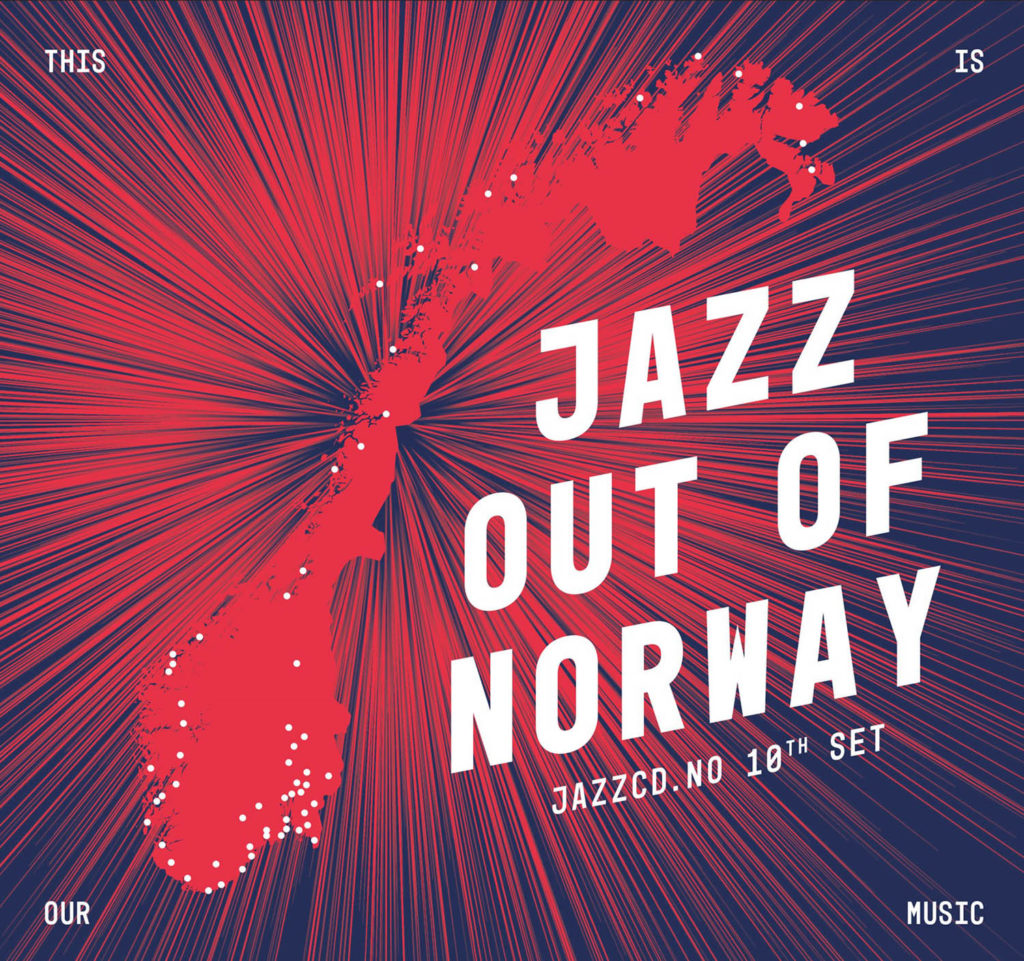
We proudly present volume five of jazzCD.no. This compilation gives a good picture of the Norwegian jazz scene today, ranging from traditional jazz and mainstream to more modern forms, including what has come to be known as the Nordic sound. JazzCD.no – 5th set shows the variety, the versatility and the quality of jazz in Norway as of 2012.
These CDs are produced promotional use internationally by The Norwegian Jazz Forum in close cooperation with The Norwegian Ministry of Foreign Affairs. The first compilation was made in 2002. Volume 5, JazzCD.no – 5th set, is available from December 2011.
JazzCD.no – 5th set:
Dag Arnesen – Solveig Slettahjell & Morten Qvenild – Olga Konkova – Arild Andersen Quintet – Solid! Feat. Seamus Blake - Espen Eriksen Trio - Hilde Louise Asbjørnsen – Roger Johansen Feat. Georg Riedel – Eyolf Dale – Kjersti Stubø – The Real Thing – Espen Rud – Håvard Stubø Quartet – Excess Luggage – Bernt Moen – Lord Kelvin – in the country – IPA – Mats Eilertsen – Steinar Raknes – Helge Lien Trio – Team Hegdal – Karl Seglem - Cortex – Flaten / Kornstad / Christensen – Hayden Powell – Trondheim Jazz Orchestra - Marius Neset & Ole Amund Gjersvik - Petter Wettre / Audun Kleive – Zanussi 5 – Motland / LonbergHolm / Solberg / Gjerstad – Sphinx - Sekstett – Splashgirl - Huntsville – 1982 - Ballrogg - Pocket Corner - Mari Kvien Brunvoll – Kitchen Orchestra - Humcrush w/ Sidsel Endresen – FriEnsemblet – Terje Rypdal w/ Bergen Big Band – Bushman’s Revenge
Liner notes jazzCD.no 5th set by Luca Vitali, jazz journalist, Bologna, Italy:
“Far too many people talk about the Norwegian scene as being «interesting because it’s so exotic». They are referring, of course, to its «Nordic Tone», that distinctive mood of snow and mountains and icy fjords. But this kind of image doesn’t focus properly on what is happening today or on the quality of the music. It’s a bit like when people talk about a girl and say ‘Yeah, she’s really nice,’ it simply doesn’t do justice to the quality of Norwegian musicians or their music.
The roots of the Norwegian scene are buried deep in the great folk tradition of the Hardanger Fiddle, a tradition that has since been influenced by maestro George Russell who succeeded in capturing its unique qualities and stimulating Jan Garbarek’s generation into taking notice of them.
Since then, this rich fabric has been further consolidated by the trail-blazing Conservatory of Trondheim which revolutionised jazz teaching with ideas that seemed simple, but were inestimably radical. Moving in completely the opposite direction to American teaching traditions, Trondheim stressed two absolute musts: ‘don’t learn the tradition, learn from the tradition’, and ‘before playing, listen’.
Norway is a young country so it doesn’t have an overbearing tradition to answer to. Its population has a large dose of national pride and for a considerable period, Norwegians also lived in relative isolation from the rest of Europe. The people also boast a spirit of adventure that dates back perhaps even to the Viking period. All this means that, today, Norway offers a highly effervescent scene with a powerful interior drive in search of a personal style. Mediated by its vocation for improvisation (the real essence of contemporary Norwegian jazz) this style is expressed in a universe of music that fuses together a vast panoply of sounds – from Ligeti to Björk via Coltrane, King Crimson and Frank Zappa – without the usual hang ups of: ‘is this jazz, or is this not jazz?’.
The answer to that is here in this compilation, which offers you the contemporary sounds of Norwegian jazz; sounds that are not necessarily based on typical jazz harmonies. This is a melting pot of cultured atonal contemporary sounds, electronic beats, jazz, and a powerful bond with nature and folk music. Without imitating their voice or phraseology, this scene has succeeded in inheriting the independent, pioneering spirit of Garbarek, Andersen, Rypdal and Christensen, the founding fathers of the Ecm generation, and therefore that heritage of emancipation from the Afro-American matrix that has made such a significant contribution to the identity of European jazz.”